The Nuclear Renaissance: Small Modular Reactors Go Commercial in 2026
For most of the twenty-first century's first two decades, nuclear energy existed in a peculiar political purgatory. It was too low-carbon to ignore for climate advocates, too expensive and slow to build for energy pragmatists, too radioactive and risky in public perception for communities, and too politically radioactive—especially after Fukushima in 2011—for legislators in most Western democracies. The result was a slow managed decline: aging plants being retired faster than new ones were built, a shrinking global workforce of nuclear engineers, and a construction industry whose last major project in the United States took sixteen years and cost twice its budget.
That picture is changing. Rapidly. In April 2026, the nuclear energy sector is experiencing a genuine renaissance, and the technology driving it is not the giant gigawatt-scale pressurized water reactors of the twentieth century but their smaller, modular successors: Small Modular Reactors, or SMRs. With the first commercial SMRs now operating in North America, Europe, and Asia, and dozens more under construction or in advanced licensing stages, the question is no longer whether SMRs will play a role in the clean energy transition—it is how large that role will be, and how quickly the industry can scale to meet the ambition.
What Makes SMRs Different
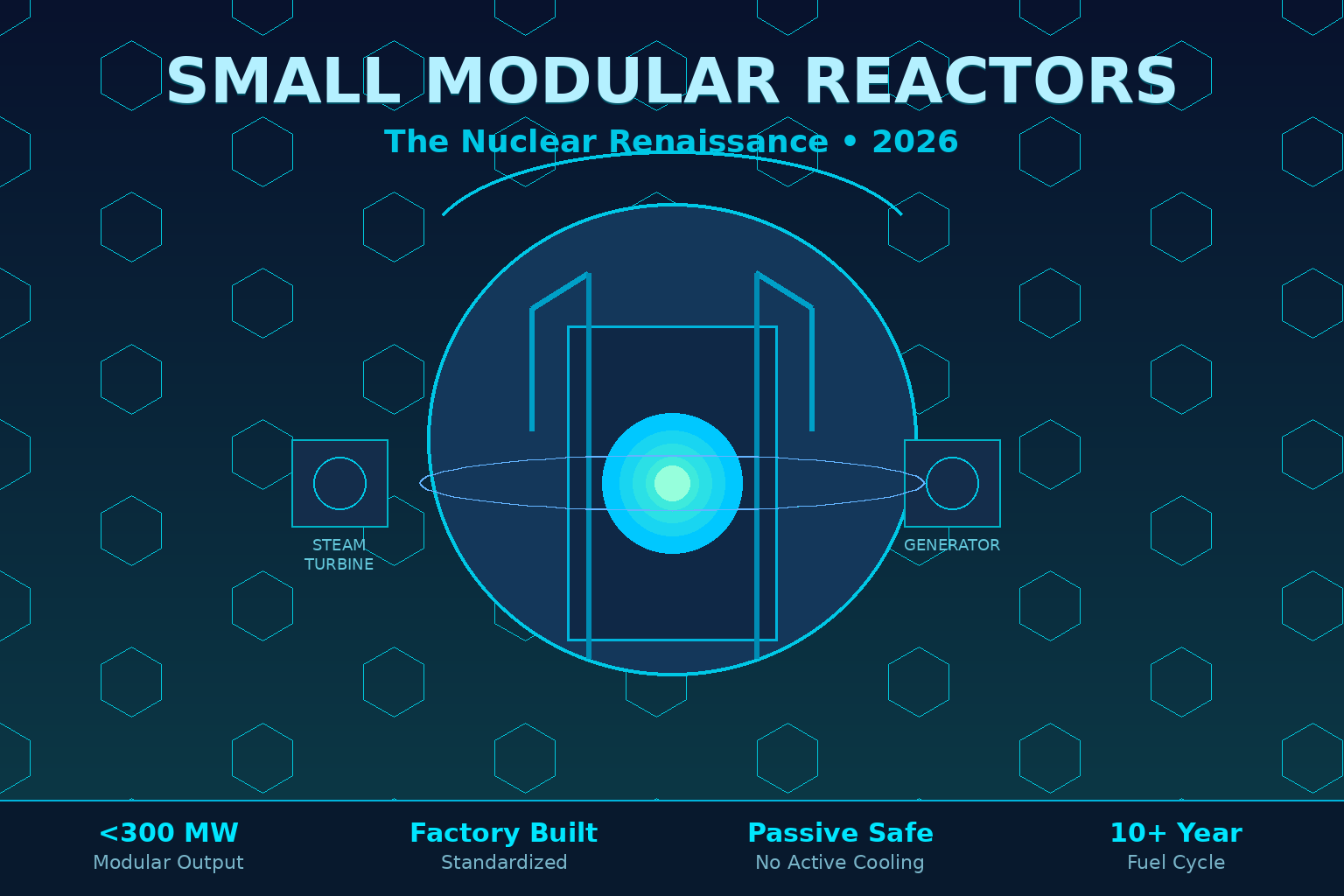
The defining characteristic of a Small Modular Reactor is in the name: it is small (typically under 300 megawatts of electrical output, compared to 1,000–1,600 MW for conventional large reactors), and it is modular (meaning its components are designed to be factory-manufactured and assembled on-site, rather than custom-fabricated for each individual plant). These two features, straightforward in description, have profound implications for the economics, deployment speed, and risk profile of nuclear energy.
Large conventional nuclear plants failed financially in recent decades primarily because of the economics of custom, first-of-a-kind construction. When every reactor is essentially a unique engineering project, built by a construction workforce that hasn't done this before, on a site with novel geology, with regulatory requirements that can evolve during a decade-long construction period, cost and schedule overruns are almost inevitable. The Vogtle Units 3 and 4 in Georgia—the most recent large reactor project completed in the United States—came in at approximately $35 billion against an original estimate under $14 billion, a sobering demonstration of the pathology.
SMRs attack this problem at its root. By constraining the power output, designers can make reactor components small enough to be manufactured in controlled factory conditions—with the quality control advantages, labor efficiencies, and learning curve benefits that factory production provides. The goal is that the fiftieth SMR unit produced will cost substantially less than the fifth, because the factory and workforce have accumulated experience, tooling has been optimized, and supply chains have been established. This learning rate dynamic, well-documented in wind and solar, has been largely absent from nuclear construction because no design has ever been built at scale. SMRs are designed specifically to achieve it.
Beyond economics, SMRs offer several technical advantages over their large predecessors. Many designs incorporate passive safety features—reactor physics and geometry that cause the chain reaction to slow or stop automatically under abnormal conditions without requiring active operator intervention or external power. This addresses one of the core failure modes of both Three Mile Island and Fukushima, where cooling system failures led to fuel damage. Several SMR designs, notably NuScale's VOYGR and TerraPower's Natrium, have received independent assessments concluding that they cannot experience the kind of uncontrolled fuel damage that defines a nuclear accident in the public imagination.
The First Commercial Deployments
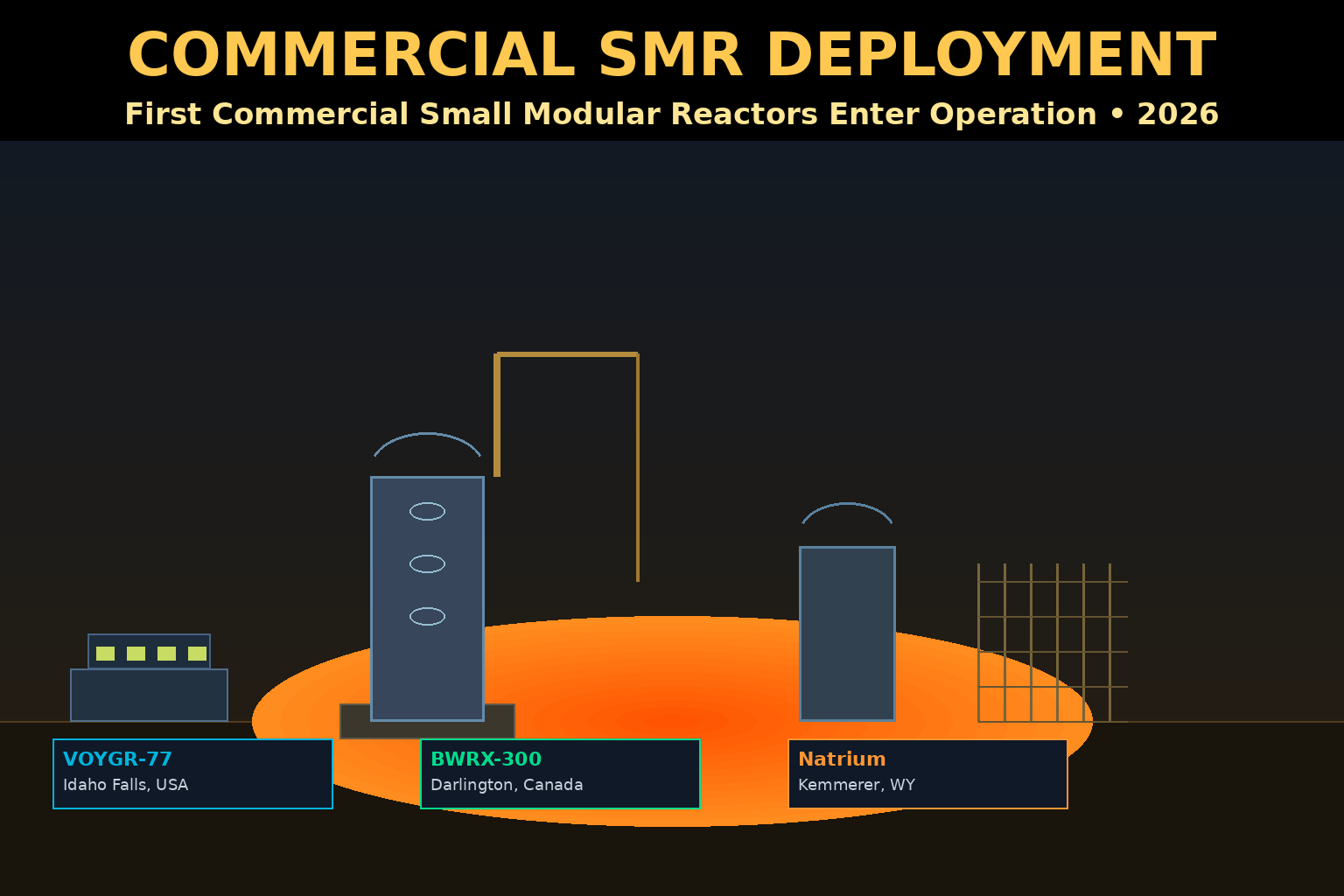
The milestone that has crystallized the nuclear renaissance narrative is the commercial operation of the first NuScale VOYGR module at the Carbon Free Power Project site in Idaho Falls, Idaho, which entered service in January 2026 after receiving its operating license from the Nuclear Regulatory Commission in late 2024. At 77 megawatts per module, a full VOYGR plant can house up to twelve modules for a combined output of roughly 924 MW—comparable to a conventional large reactor but deployable in stages, with each module addition representing an incremental capital commitment rather than a single enormous bet.
The Idaho plant's first months of operation have been closely watched by the entire energy industry. The performance data, while preliminary, has been broadly encouraging. Capacity factors—the percentage of time the reactor operates at full power—have exceeded 90% in the first quarter, consistent with the operating record of large conventional reactors. The passive safety systems have performed as designed in multiple planned test shutdowns. And critically, the levelized cost of electricity (LCOE) from the first module, while still above the current cost of wind and solar in favorable locations, is tracking below the worst-case projections and within the range that makes SMRs competitive as firm, dispatchable clean power—a role that intermittent renewables cannot fill without massive and still-expensive grid-scale storage.
The NuScale deployment is not alone. In Canada, the Ontario Power Generation's Darlington New Nuclear Project broke ground in March 2025 on a GE Hitachi BWRX-300 SMR—a 300-MW boiling water design that OPG has described as the fastest-tracked nuclear project in North American history, targeting commercial operation by 2029. In Poland, where the government has committed to building six to nine nuclear units to replace coal power and reduce energy dependence on Russian natural gas, contracts for both large-scale AP1000 reactors and SMRs are moving forward simultaneously. In the UK, Rolls-Royce SMR has received development consent for its first site and is targeting a final investment decision in late 2026.
In China—where the pace of nuclear construction has never really slowed, even as Western programs stalled—the state-owned CNNC commissioned a demonstration high-temperature gas-cooled reactor (HTR-PM) in Shandong province in December 2023 and is now deploying commercial versions. Chinese firms are also marketing SMR technology internationally through BRI infrastructure lending, creating a geopolitical dimension to the SMR race that has attracted significant attention in Washington and Brussels.
The Technology Spectrum
Not all SMRs are alike, and the variety of designs currently in development reflects fundamentally different approaches to reactor physics, fuel, and coolant that will have long-term implications for cost, safety, and applicability.
Light water SMRs like NuScale and BWRX-300 use conventional enriched uranium fuel and water as both coolant and moderator—essentially scaled-down versions of proven conventional reactor technology. Their primary advantages are regulatory familiarity (regulators know how light water reactors behave) and fuel supply chain maturity. Their limitations include the same efficiency constraints as conventional nuclear.
Molten salt reactors, being developed by companies including Terrestrial Energy and Moltex, use liquid fluoride or chloride salts as coolant instead of water. This allows operation at higher temperatures and lower pressures than light water designs, potentially enabling more efficient electricity generation and high-temperature industrial heat applications. The technology is less proven at commercial scale but has attracted substantial capital from investors betting on its long-term advantages.
Fast reactors and advanced fuels represent the most technically ambitious segment of the SMR landscape. TerraPower's Natrium design, backed by Bill Gates and a $2 billion Department of Energy cost-share, uses a sodium-cooled fast reactor with a molten salt energy storage system that can modulate output to follow grid demand—a capability that addresses one of nuclear energy's traditional criticisms that it can only operate as baseload, not as flexible generation. The Natrium demonstration plant in Kemmerer, Wyoming, is targeting completion in 2030.
The Political and Economic Drivers
The SMR revival is not occurring in a vacuum. It is being actively pushed by a convergence of policy forces that has assembled a coalition around nuclear energy that would have seemed implausible a decade ago.
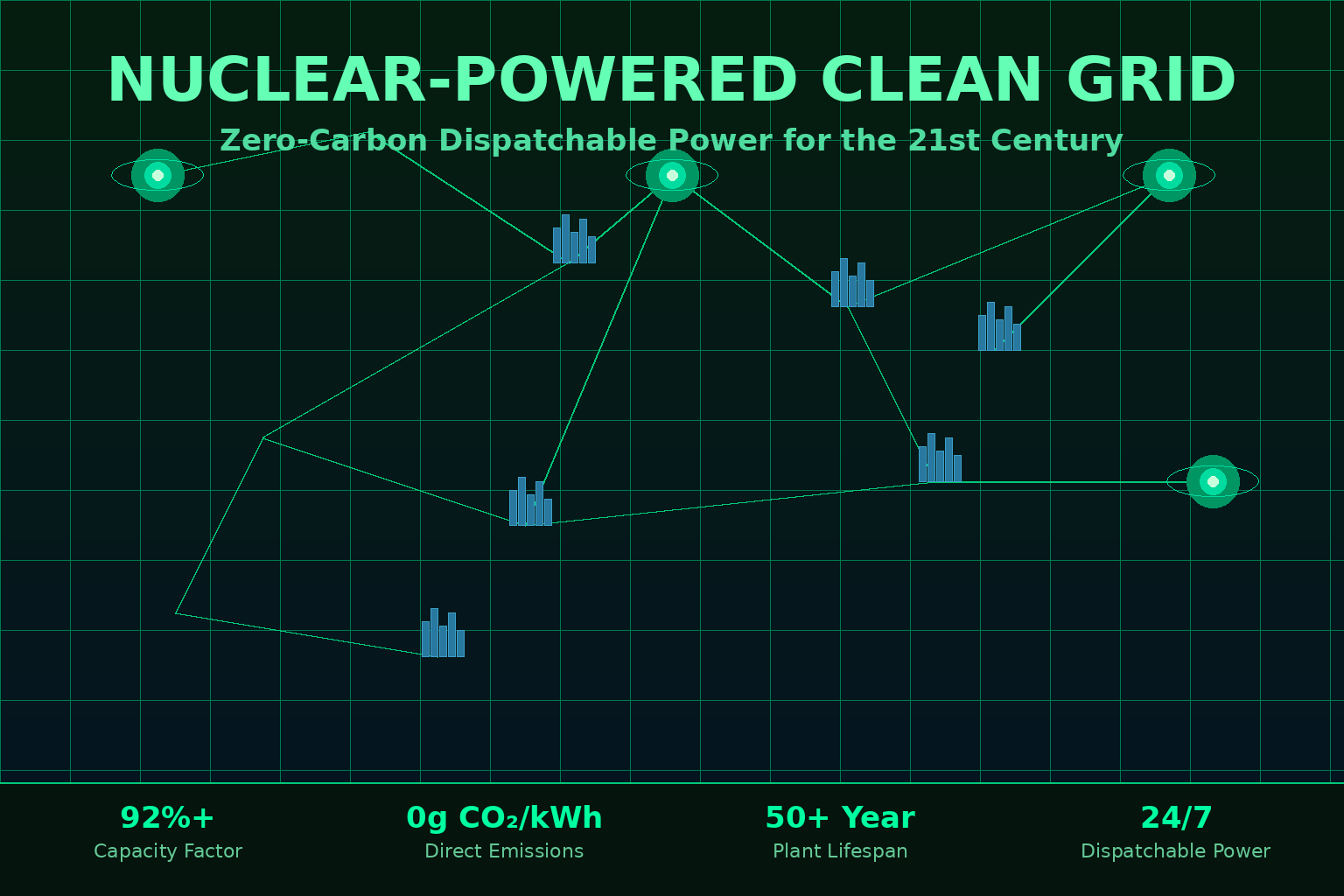
Climate policy has become the dominant argument for nuclear. As the limits of solar and wind as standalone solutions—their intermittency, their land use requirements, their storage dependencies—have become clearer to serious energy analysts, the appeal of dispatchable clean generation has increased. Nuclear produces no direct carbon emissions, operates at very high capacity factors regardless of weather or season, and has one of the smallest land footprints per unit of energy produced of any major source. The Intergovernmental Panel on Climate Change's most recent scenarios for limiting warming to 1.5°C all include significant nuclear growth. The International Energy Agency, which for years declined to take strong positions on nuclear, has explicitly called for a doubling of nuclear capacity by 2050 as part of its net-zero pathway.
Industrial energy demand has created a new customer class. The explosion of AI data center construction—requiring vast quantities of reliable, around-the-clock electricity—has pushed technology companies into direct nuclear power procurement. Microsoft has signed a long-term power purchase agreement with Constellation Energy to restart Three Mile Island Unit 1 (rebranded Crane Clean Energy Center), which came back online in September 2024. Google has contracted with Kairos Power for an SMR fleet that will provide power to its data centers beginning in 2030. Amazon Web Services has agreements with both X-energy (advanced reactor technology) and Dominion Energy for nuclear-sourced power. These corporate contracts, denominated in long-term fixed prices, are providing exactly the financial certainty that SMR developers need to attract project financing.
Geopolitics has revalued energy security. Russia's invasion of Ukraine in 2022 and the resulting restructuring of European energy supply chains reminded governments that energy dependence is a strategic vulnerability. For countries—Poland, the Czech Republic, Sweden, Finland, South Korea, Japan—reconsidering their energy mix through the lens of supply security, domestic nuclear production has a compelling advantage: the fuel is compact, relatively easy to stockpile, and sourceable from politically stable suppliers. A country with a domestic nuclear fleet is simply less exposed to the kind of energy coercion that Russia was able to exercise over much of Europe in 2022.
Challenges That Remain
The nuclear renaissance is real, but it is not a solved problem. Several significant challenges stand between the current state of SMR deployment and the scale required to make nuclear a material contributor to decarbonization targets.
Cost remains unproven at scale. The central promise of SMRs—factory economics and learning rates that will drive down cost over successive units—has not yet been validated by commercial data. The NuScale Idaho plant is a first-of-a-kind commercial deployment, and first-of-a-kind costs in any technology are substantially higher than nth-of-a-kind costs. The question is whether the industry will succeed in building enough units, fast enough, to achieve the scale economies that the business case depends upon. Several SMR projects that were announced with significant fanfare in 2022–2023—including a NuScale project in Utah that was cancelled after subscriber utilities withdrew due to escalating cost estimates—have reminded the industry that the path from design to commercial scale is neither straight nor guaranteed.
Nuclear waste remains a political and regulatory challenge. The fundamental physics of nuclear fission produces radioactive byproducts that must be managed for thousands of years. No country has yet opened a permanent deep geological repository for high-level nuclear waste—Finland's Onkalo facility, the world's first, is scheduled to receive waste in the late 2020s but is not yet operational. In the United States, the absence of a permanent repository remains a legal and political obstacle to nuclear expansion, with the Yucca Mountain site having been effectively abandoned despite decades of investment. SMRs do not solve the waste problem and, in some configurations, produce different waste streams (particularly advanced fast reactors using enriched or alternative fuels) whose disposal pathways are less well-established than conventional spent fuel.
The workforce pipeline is critically constrained. The decades-long decline of nuclear construction activity in Western countries left a workforce gap that cannot be closed quickly. Nuclear engineers, reactor operators, NRC-certified inspectors, specialized welders and pipefitters with nuclear quality assurance qualifications—all are in short supply and take years to train. Universities, national laboratories, and industry associations are all reporting recruitment and training programs at record levels, but the scale of expansion required means that workforce constraints will be a binding limitation on SMR deployment rates for at least the next five to eight years.
Public acceptance remains variable. Despite a measurable shift in public opinion toward nuclear energy over the past five years—driven primarily by climate concern among younger generations that had previously been the most anti-nuclear demographic—nuclear projects still face organized local opposition, permitting challenges, and political vulnerability in many markets. Germany's decision to proceed with its nuclear phase-out in 2023, even as the energy crisis driven by the Ukraine war was straining European grids, illustrated that public and political opposition to nuclear can override pragmatic energy arguments in democratic systems.
The nuclear renaissance of 2026 is, in the end, a story about technology meeting a historical moment. The technology has matured to the point where SMRs are commercially deployable and technically credible as a clean energy solution at meaningful scale. The moment—defined by climate urgency, AI energy demand, geopolitical energy insecurity, and the demonstrated limits of solar-wind-storage alone—has created a policy and investment environment more favorable to nuclear than any in the past four decades. Whether the industry can execute at the speed and scale the moment demands is the defining question of the nuclear renaissance, and the answer will not be clear for at least another decade.
What is clear today is that nuclear energy is no longer dying. It is building.