The Green Hydrogen Revolution: How Clean Fuel Is Reshaping the Global Energy Economy in 2026
On the morning of April 3, 2026, the supertanker Horizon Elektra docked at the Port of Rotterdam carrying 8,000 tons of liquefied green hydrogen produced at a solar-powered electrolysis facility on the coast of Namibia. The shipment, the largest of its kind in history, was a commercial transaction—not a demonstration project, not a government-subsidized pilot, but a straightforward trade of clean fuel produced where renewable energy is cheap and consumed where industrial demand is high. That moment, nearly unnoticed outside of energy industry circles, marks a turning point in the global energy economy.
The green hydrogen revolution has arrived. After a decade of promises, engineering challenges, and cost curves that stubbornly refused to bend, the confluence of unprecedented renewable energy build-out, dramatic electrolyzer cost reductions, supportive policy frameworks on three continents, and surging industrial demand for decarbonization has pushed green hydrogen across the threshold from "promising technology" to "commercially competitive energy carrier." The transition is not complete—it will take decades to fully unfold—but the direction is now unmistakable.
Understanding the Green Hydrogen Advantage
Before examining where green hydrogen stands in April 2026, it is worth stepping back to understand why it matters so profoundly to the energy transition.
The world has made remarkable progress electrifying transportation and power generation. Solar panels, wind turbines, and electric vehicles have followed remarkable cost-reduction curves—the economics of wind and solar are now so compelling that new renewable capacity is consistently the cheapest source of new electricity generation in most of the world. But electrification alone cannot decarbonize the entire economy. Certain sectors are deeply resistant to direct electrification:
Heavy industry—steel, cement, aluminum, chemicals—requires extremely high-temperature heat that is difficult and expensive to generate with electricity at industrial scale. These sectors collectively represent about 20–25% of global carbon emissions and have historically had no credible low-carbon pathway.
Long-haul and heavy freight—maritime shipping, long-distance trucking, aviation—requires energy-dense fuels that can be stored in reasonably compact containers. Battery technology, despite its progress, cannot yet provide competitive energy density for vessels crossing oceans or aircraft flying intercontinental routes.
Seasonal energy storage—the sun doesn't shine and wind doesn't blow consistently, and while batteries are ideal for short-duration storage, they are impractical for storing summer solar surplus to cover winter heating demand. A different medium is needed.
Green hydrogen—produced by using renewable electricity to split water molecules into hydrogen and oxygen via electrolysis, with zero direct carbon emissions—addresses all three of these hard-to-abate sectors. It can be burned to produce industrial heat, stored and later reconverted to electricity via fuel cells, synthesized into green ammonia or methanol for shipping fuel, or fed into industrial processes that currently rely on fossil fuels as feedstocks.
The catch has always been cost. Until recently, green hydrogen was two to four times more expensive than "grey" hydrogen produced from natural gas, and five to ten times more expensive than simply burning the natural gas directly. Those economics are changing—rapidly and fundamentally.
The Cost Curve Inflection: Electrolyzers in 2026
The single most important development in green hydrogen's commercial emergence is the dramatic reduction in electrolyzer costs—the capital cost of the equipment that uses electricity to split water. In 2020, alkaline electrolyzers (the workhorse technology) cost approximately $1,000–$1,200 per kilowatt of capacity. By early 2026, large-scale deployments are achieving installed costs below $350/kW for alkaline systems and approaching $400/kW for proton exchange membrane (PEM) systems that offer faster response times and higher pressure outputs.
This cost reduction—roughly 65% in six years—follows a learning rate (percentage cost reduction per doubling of cumulative installed capacity) of approximately 18%, similar to the early solar PV curve. Importantly, the installed base is growing fast enough to sustain this trajectory. Global electrolyzer installations reached 12 gigawatts (GW) in 2025 alone—more than all prior years combined—and projections for 2026 point to 20–25 GW of new capacity coming online.
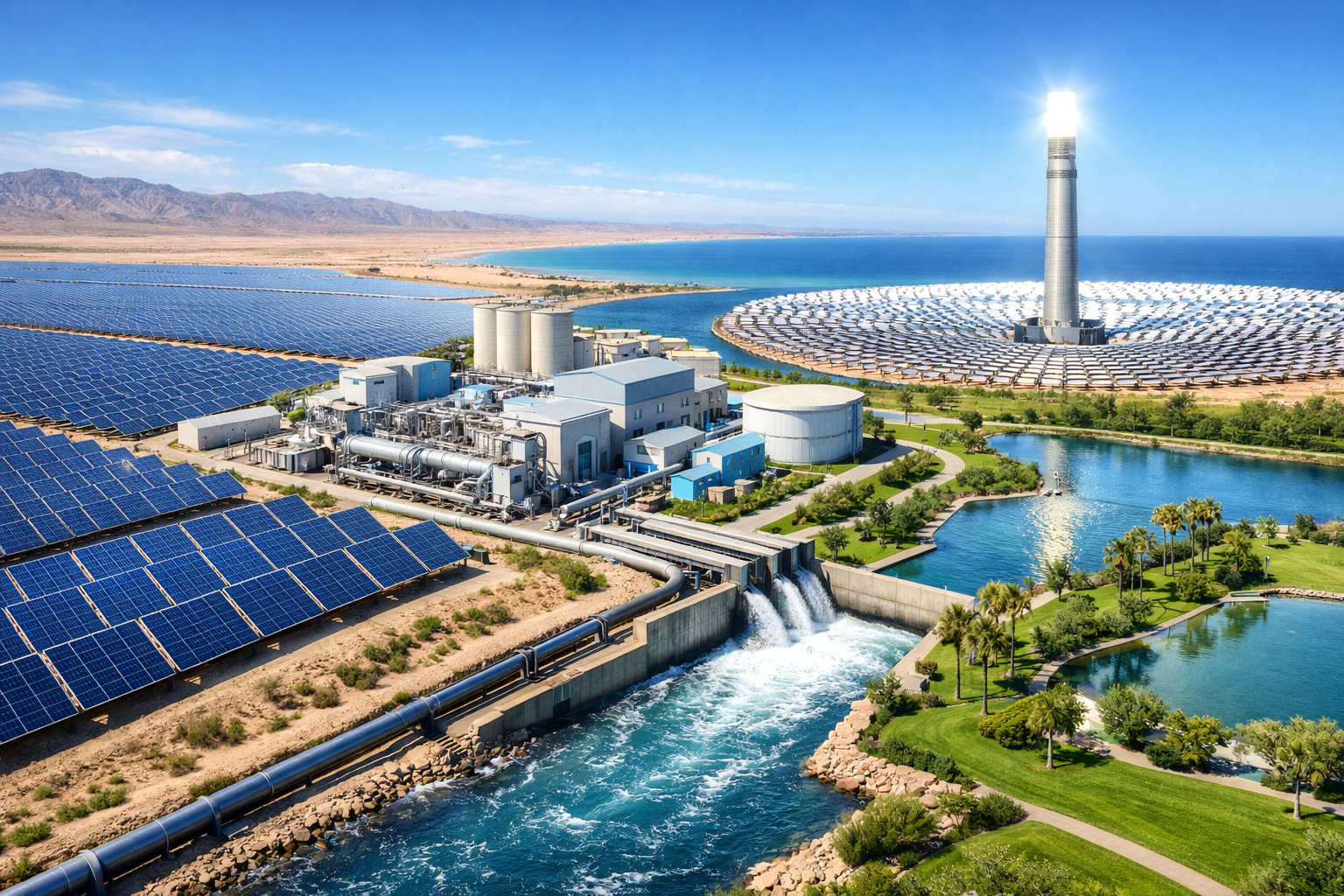
The implications for green hydrogen economics are dramatic. In regions with world-class renewable resources—the Atacama Desert in Chile, the Sahara, the Pilbara in Western Australia, the Horn of Africa, coastal Oman—green hydrogen is already being produced at costs of $1.80–$2.20 per kilogram. Grey hydrogen from natural gas, when properly accounting for the full cost of carbon, is approaching $2.50–$3.00/kg in many markets. For the first time, the economics are tilting in green hydrogen's favor in the most advantaged locations.
The target that energy economists have long cited as the threshold for widespread competitiveness—$1.50/kg "green hydrogen at the electrolyzer gate"—is now visible on the near-term horizon, with the most optimistic credible projections placing it within reach by 2028–2030 in the best-resourced regions.
The New Map of Global Energy Trade
One of the most geopolitically significant dimensions of the green hydrogen revolution is how it is redrawing the map of global energy trade. The geography of fossil fuels—concentrated in the Middle East, Russia, North America, and parts of Africa—is not the geography of renewable energy potential. Sunlight and wind are far more evenly distributed, and some of the world's poorest countries sit atop extraordinary renewable resource endowments.
Namibia, profiled in the opening of this article, is the leading example. The Hyphen Hydrogen Energy project in the Tsau//Khaeb National Park represents a $10 billion investment in solar and wind generation paired with electrolysis capacity sufficient to produce 300,000 tons of green hydrogen annually by 2027. The project is expected to generate more export revenue for Namibia than all other exports combined—a potential transformation of a nation that has historically struggled to monetize its renewable resource abundance.
Chile is further along the curve. The country's H2Chile strategy, backed by aggressive government policy and a natural abundance of solar irradiation in the Atacama and wind resources in Patagonia, has attracted over $40 billion in committed investment. Chile aims to export 2 million tons of green hydrogen annually by 2030, positioning itself as a key supplier to Asia-Pacific markets, especially Japan and South Korea, which have limited renewable land area relative to their industrial energy demand.
Australia has emerged as perhaps the most significant prospective exporter to Asia, combining world-class solar and wind resources with an existing infrastructure of LNG export terminals that can be repurposed or complemented for hydrogen and ammonia shipment. The Australia-Japan Green Hydrogen and Ammonia Corridor, formalized in 2025, has become a template for bilateral clean energy trade arrangements that several other country pairs are now emulating.
The Gulf States, historically dependent on hydrocarbon exports, have made a strategic pivot to hydrogen as a long-term hedge. Saudi Arabia's NEOM Helios green ammonia project—perhaps the world's largest single clean energy project at $8.4 billion—is designed to produce 1.2 million tons of green ammonia per year powered by 4 GW of dedicated solar and wind capacity. The project began commercial production in Q4 2025 and is now ramping toward full capacity.
Industrial Decarbonization: Steel, Ammonia, and Chemicals
The most economically significant near-term application for green hydrogen is not transportation fuel but industrial feedstock replacement—substituting fossil fuels and fossil-derived hydrogen in manufacturing processes.
The steel industry is the paradigmatic example. Conventional blast furnace steelmaking uses coking coal both as a fuel and as a chemical reducing agent—it reacts with iron ore to strip away oxygen atoms and produce iron. Green hydrogen can serve as a direct replacement reducing agent (the reaction is Fe₂O₃ + 3H₂ → 2Fe + 3H₂O), with water vapor instead of CO₂ as the byproduct. This process, called direct reduced iron (DRI) with hydrogen, is now commercially operational at industrial scale.
SSAB's HYBRIT project in Sweden has been producing commercially sold fossil-free steel since 2023. Thyssenkrupp's Direct Reduced Iron plant in Duisburg, Germany—powered by a dedicated pipeline from North African green hydrogen producers—began full commercial operations in early 2026. H2 Green Steel, a Swedish startup that has become something of a unicorn of the industrial decarbonization space, broke ground in Boden, Sweden in 2025 with a facility targeting 2.5 million tons of green steel annually by 2030.
The cost premium for green steel remains significant—approximately 20–30% above conventional steel in April 2026—but it is narrowing as electrolyzer costs fall and as carbon pricing mechanisms in Europe and increasingly elsewhere make the "hidden cost" of conventional steelmaking more visible in market prices. Several major automotive manufacturers, including Volkswagen, BMW, and Volvo, have signed long-term off-take agreements for green steel, providing the revenue certainty that enables plant construction at scale.
Ammonia is the other critical industrial application. Ammonia (NH₃) is the basis of virtually all nitrogen fertilizers—without it, global agriculture could not feed the current human population. Roughly 180 million tons of ammonia are produced annually, almost entirely from natural gas via the Haber-Bosch process, accounting for approximately 1.8% of global CO₂ emissions. Green ammonia—produced from green hydrogen combined with nitrogen separated from the air—is now commercially competitive in several markets and is beginning to capture meaningful market share.
Challenges: Infrastructure, Safety, and the Valley of Death
For all the progress, the green hydrogen revolution faces genuine and substantial challenges that will determine whether its trajectory continues upward or plateaus in a "valley of death" of partial deployment.
Infrastructure is the most immediate constraint. Hydrogen is the lightest element in the universe, and its physical properties make it challenging to store and transport. It has very low volumetric energy density—roughly 35 times less energy per cubic meter than natural gas at standard conditions—which means either high-pressure compression, liquefaction to cryogenic temperatures (−253°C), or conversion to a carrier molecule like ammonia or liquid organic hydrogen carriers (LOHCs) is required for efficient transport. Each of these options adds cost and complexity. Building out the pipelines, port facilities, and storage infrastructure needed for a hydrogen economy requires hundreds of billions of dollars of investment that will not earn returns for many years.
Safety considerations require careful management. Hydrogen's wide flammability range (4–75% concentration in air) and very low ignition energy demand new safety protocols in manufacturing facilities, ports, and distribution systems. The industry has decades of safe experience handling hydrogen in industrial contexts, but extending that safety record to broader commercial and consumer applications requires education, regulation, and engineering investment.
The policy cliff looms for projects that have been structured around specific incentive frameworks. The US Inflation Reduction Act's clean hydrogen tax credits (Section 45V) have been a critical catalyst for American green hydrogen development, but their long-term continuity in the current political environment is uncertain. Projects that depend on these credits face real development risk if the policy landscape shifts.
The Road Ahead: Milestones for a Hydrogen Economy
By 2030, the International Energy Agency projects that green hydrogen production costs in the most advantaged regions will fall to $1.50/kg or below—the widely cited threshold for broad competitiveness with fossil alternatives when carbon costs are included. By that point, the cumulative installed electrolyzer base is expected to exceed 200 GW globally, down from just 35 GW today.
The decade from 2026 to 2036 will likely see green hydrogen transition from an emerging industry to a foundational pillar of the global energy system. The trade routes being established today—from Namibia to Rotterdam, from Australia to Japan, from Chile to South Korea—are the early sketches of an energy geography that will look radically different from the one that defined the 20th century.
For countries with abundant renewable resources and aspirations for economic development, green hydrogen represents one of the most compelling opportunities in decades. For energy-importing industrial nations, it offers the prospect of a decarbonized industrial base that does not sacrifice economic competitiveness. For the global climate, it provides a credible pathway to decarbonize sectors that have long seemed intractable.
Conclusion: A New Energy Age Is Being Written Right Now
The docking of the Horizon Elektra in Rotterdam on April 3, 2026, was not a symbolic gesture. It was a commercial shipment in a growing market—a data point in a trend that will reshape geopolitics, industrialize new regions, and determine whether humanity can achieve net-zero emissions without sacrificing the industrial foundations of modern civilization.
Green hydrogen will not solve every energy problem, and it will not displace oil and gas overnight. But the trajectory is clear, the economics are moving in the right direction, and the infrastructure investments being made today are locking in a future that was, just a few years ago, considered impractically optimistic. The green hydrogen revolution is no longer a revolution waiting to happen. It is happening—shipload by shipload, gigawatt by gigawatt, steel billet by steel billet—right now.