The Global AI Infrastructure Race: Data Centers, Power, and the New Geopolitics of Computing in 2026

Something historic is happening in the physical world that rarely surfaces in the headlines about artificial intelligence. While public attention focuses on model benchmarks, chatbot capabilities, and the latest multimodal parlor tricks, an unprecedented mobilization of capital and engineering talent is reshaping the literal landscape of the planet. Across four continents, governments and corporations are racing to build the physical infrastructure that AI requires to function at scale: the data centers, the power plants, the water systems, the transmission lines, and the chip fabrication facilities that underpin every model inference, every agent decision, every AI-assisted medical diagnosis, legal brief, and software deployment that occurs anywhere in the world.
The numbers are staggering. In 2024, global data center construction investment crossed $200 billion for the first time. By the end of 2025, that figure had risen to an estimated $340 billion. The projections for 2026 range from $450 billion to over $600 billion, depending on whether the current acceleration in hyperscaler and sovereign AI infrastructure spending continues at its present pace. To put this in context: the world is, in a single year, spending more on AI-supporting physical infrastructure than the entire annual GDP of several G20 nations.
This is not a technology story. It is a story about energy, land, water, labor, and raw political power—and the nations and corporations that understand this soonest will hold structural advantages in the AI era that no software update can erase.
The Power Problem That Defines Everything
No constraint shapes the AI infrastructure race more fundamentally than electricity. Modern AI training and inference are extraordinarily power-intensive operations. A large language model training run can consume as much electricity as a small city uses in a year. Inference—the continuous, real-time process of responding to user queries and running agent tasks—adds a steady-state load that grows directly with adoption. Every new enterprise AI deployment, every consumer AI feature rolled out to hundreds of millions of smartphones, and every autonomous AI agent completing tasks in the background adds incrementally to a global electricity demand that data center operators, grid operators, and energy investors are struggling to anticipate and meet.
The data center industry's power demand has effectively moved from being a grid planning footnote to being a primary driver of energy investment in the United States, Europe, and increasingly Asia. In Virginia's Loudoun County—the world's largest data center market—the local utility, Dominion Energy, has a data center interconnection queue exceeding 40 gigawatts of requested capacity. For reference, the entire state of Virginia's peak electricity demand is roughly 20 gigawatts. The data centers want more power than the rest of the state combined, and they want it within five years.
Virginia is not an anomaly. Northern Ireland, Wales, Singapore, Osaka, Dubai, and a dozen emerging data center markets in Southeast Asia, the Middle East, and Latin America are all facing versions of the same arithmetic: the requested power capacity from new data center developments exceeds current grid capacity and is outpacing even aggressive grid expansion plans.

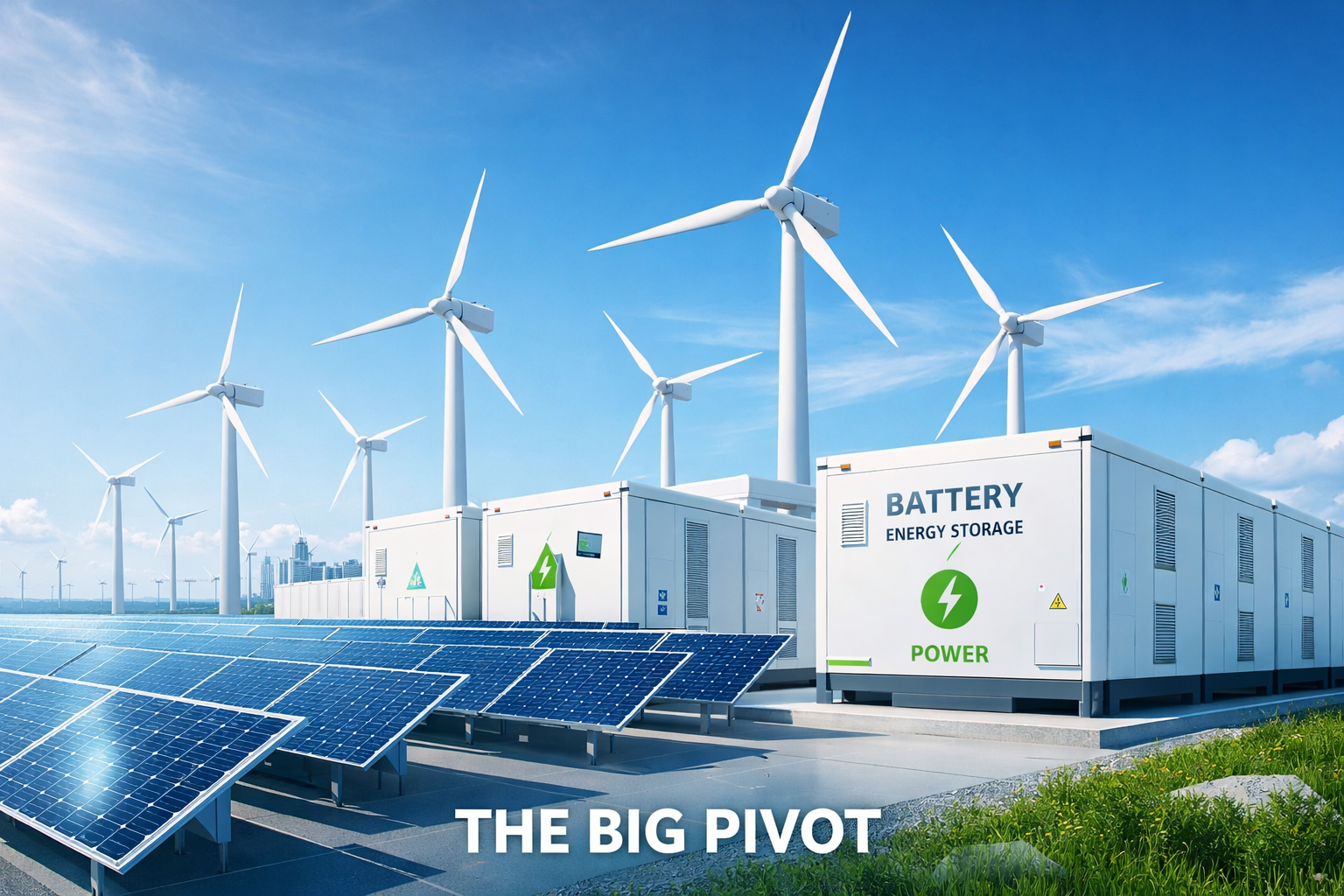
This constraint is driving a convergence between the AI industry and the energy industry that would have seemed unlikely three years ago. The largest hyperscalers—Microsoft, Google, Amazon, and Meta—have all signed long-term power purchase agreements (PPAs) for nuclear energy in the past eighteen months. Microsoft's deal with Constellation Energy to restart Three Mile Island's Unit 1 reactor was the highest-profile early move, but it has been followed by a cascade of similar agreements: Amazon's investment in X-energy's advanced reactor program, Google's partnership with Kairos Power for high-temperature gas-cooled reactors, and Meta's announcement of a dedicated 1-gigawatt nuclear-powered campus in the American Midwest.
The strategic logic is straightforward: nuclear power offers the combination of 24/7 availability, carbon-free generation, and large-block capacity that AI workloads require and that intermittent renewable sources cannot reliably provide. The AI industry's embrace of nuclear energy is one of the most significant developments in energy investment since the shale revolution—and unlike shale, it cuts in the direction of decarbonization rather than away from it.
The Semiconductor Supply Chain as Strategic Chokepoint
If power is the operational constraint on AI infrastructure, the semiconductor supply chain is the strategic chokepoint—and it is a chokepoint that has become thoroughly geopoliticized over the past three years.
The AI chip market is, at its heart, a story about NVIDIA's continued dominance, the ferocity of the challenge to that dominance, and the extraordinary political sensitivity that now surrounds the design, fabrication, and export of the most advanced silicon. NVIDIA's H100 and subsequent Blackwell architecture GPUs remain the workhorses of AI training worldwide, and the company's revenue and market capitalization reflect a degree of market power that draws comparisons to Standard Oil in its era of peak dominance.
But the competitive and geopolitical landscape around NVIDIA has become dramatically more complex in 2026. AMD's MI300X and its successors have carved out meaningful share in the inference market. Google's TPU v5 and Amazon's Trainium chips are increasingly displacing third-party silicon for hyperscalers' own workloads. And a cohort of AI chip startups—Cerebras, Groq, Tenstorrent, and Etched among them—have all shipped competitive products that are finding niches in the market.
The geopolitical dimension is more fraught. U.S. export controls on advanced AI chips to China have tightened progressively since 2022, culminating in a set of restrictions announced in late 2025 that effectively bars the export of any chip with AI performance metrics exceeding a threshold that covers all frontier hardware. China has responded with a comprehensive national program to develop domestic AI chip capability centered on Huawei's Ascend series, Cambricon's latest offerings, and a substantial government-funded research program aimed at achieving process-technology parity with TSMC within a decade.
The result is an emerging bifurcation of the global AI hardware ecosystem—a "chip wall" that mirrors the Iron Curtain in its geographic scope and its implications for which nations can participate in frontier AI development and at what cost. Countries and companies that are caught between the two blocs—unable to access U.S.-ecosystem chips at scale but unwilling to commit fully to the Chinese alternative—face a genuine strategic dilemma with no clean resolution in sight.
Sovereign AI: Nations Entering the Race Directly
One of the most significant structural developments in AI infrastructure in 2026 is the emergence of sovereign AI as a major category of government investment. A growing number of nations have concluded that dependence on foreign AI infrastructure—particularly hyperscaler cloud platforms owned by U.S. or Chinese companies—represents an unacceptable strategic vulnerability, and are investing in national AI infrastructure programs to reduce that dependence.
The European Union's AI Gigafactories initiative, announced in early 2025 and now in active construction, aims to create at least five large-scale AI compute clusters on European soil by 2027, using European-regulated data governance and European power sources. The UAE's AI Campus in Abu Dhabi, Saudi Arabia's NEOM AI infrastructure program, India's National AI Mission compute buildout, and Japan's AI Computing Initiative represent similar impulses across different geopolitical contexts—each nation seeking to ensure that it has sufficient indigenous AI computing capacity to conduct sovereign AI development, host sensitive applications locally, and avoid strategic dependence on external providers.
For the hyperscalers, sovereign AI programs are simultaneously a competitive threat and a business opportunity. Governments that build their own compute clusters are potential competitors to cloud services, but they are also customers for the hardware, software, and technical expertise required to build and operate them. Microsoft Azure Government, AWS GovCloud, and Google's Sovereign Cloud offerings have all grown substantially as intermediary products—providing cloud services with enhanced data residency, access control, and compliance features designed to meet sovereign AI requirements without requiring governments to build entirely from scratch.
The competition for sovereign AI contracts has become a new arena of diplomatic and commercial rivalry, with chip makers, hyperscalers, and national governments all maneuvering for position in what analysts are calling a "great compute scramble" that will define the geopolitical technology landscape for at least a decade.
The Investment Wave and What Comes After
The current AI infrastructure investment wave is unlike any capital deployment cycle in the history of technology. The sheer scale—measured in hundreds of billions of dollars annually—the geographic breadth, the number of actors involved, and the political salience of the decisions being made all distinguish this moment from previous infrastructure booms in their intensity.
What does this wave produce? In the near term: a massive expansion of global computing capacity, an acceleration of AI capability deployment that compounds on itself, and a set of new chokepoints and dependencies around energy, water, and chip supply chains that will generate their own downstream dynamics.
In the medium term, the question that every serious technology economist is examining is whether the AI infrastructure wave will deliver returns commensurate with the investment. The historical precedent of previous infrastructure investment cycles—from railroad overbuilding in the nineteenth century to fiber-optic overbuilding in the late 1990s—suggests that infrastructure buildouts of this scale often produce excess capacity in the short term, followed by a shakeout, followed by a period in which the excess capacity becomes the foundation for an entirely new generation of applications and economic activity that the original investors could not fully anticipate.
There is reason to believe that AI infrastructure will follow a version of this pattern. The data centers being built today are being designed for workloads that don't fully exist yet—inference demand from AI agents, embodied AI robotics, real-time AI systems embedded in every surface and device and process. Whether that demand materializes quickly enough to justify the capital being deployed is the defining uncertainty of the AI infrastructure moment, and it will not be resolved cleanly or quickly.
What is not uncertain is that the race is real, the stakes are high, and the countries and companies that understand the physical requirements of the AI future—not just the software—will hold the positions of structural advantage that matter most.